History
Plano History
The community of Plano originated during the early 1840s in the Republic of Texas. Prior to that, the area was inhabited by members of the Caddo and Wichita tribes. Most of the early pioneers were small groups of Anglo-American settlers who migrated from Kentucky and Tennessee to the fertile Blackland Prairie of Collin County. They were part of the Peters Colony settlement of north central Texas.
Mail service was established around 1850 and the scattered settlements became a closer community. Plano, a Spanish word for flat, an apt description of the area’s topography was suggested as the name of the town. Raising livestock and farming provided the economic base. Churches and schools were built and local businesses began to prosper. In the closing years of the 1850s growth was steady, but came to a standstill with the beginning of the Civil War in 1861. When the South surrendered in 1865, the men began to return to Plano to pick up their run-down farms and persist again. More businesses were opened and new people were attracted to the area.
The arrival of the Houston and Texas Central (H&TC) Railroad in 1872 played a prominent role in shaping the community growth and population. The city was incorporated in June, 1873 and platted the same year in a traditional grid pattern oriented to the H&TC Railroad tracks. The business district pattern that remains in place today was destroyed by fires in late 1800s. The intense rebuilding efforts resulted in replacing wood-framed structures with more substantial brick buildings. Other modern alterations occurred during the 1930s and the post-World War II era as well as suburbanization that began in the 1950s with the construction of the North Central Expressway, now designated as U. S. Highway 75.
For the first eighty years of its existence, Plano, Texas was a small town in the southwest corner of Collin County with an economy based on the area’s production of cotton and grain. Tremendous growth that occurred in the post-World War II era resulted in Plano becoming one of the fastest-growing cities in Texas and the United States. According to the U.S. Census Bureau, Plano is the ninth largest city in the state. Although Plano is now home to numerous national corporations that contribute to North Texas’ vibrant economy, its growth and the nature of its spirit can still be traced back to the first settlers who arrived 175 year ago.
Historic Tour
The Discovering Old Plano Historic Tour highlights many of the sites and buildings that were significant in the early years of Plano’s history. Two tour routes are provided – one through historic neighborhoods and the other through the historic downtown business district. Additional historical sites across the city have also been included that are not part of a designated route.
Sidewalk Markers
Sidewalk Markers are stone plaques located in the sidewalks around downtown that memorialize the location of buildings and sites that have not survived, but that made a significant contribution to the history of Plano.
City of Plano Heritage Resources
This symbol denotes the item has been officially designated by the City of Plano as an Individually Designated Heritage Resource. These local landmarks may be located within or outside of a designated Heritage Resource District.
National Register of Historic Places
This symbol denotes the item has been included on the National Register of Historic Places by the National Park Service. The Downtown Plano National Register District includes 32 contributing properties.
Plano Conservancy Wayside Signs
This symbol indicates the item has a Wayside Sign. These informational signs have been installed at several locations significant to Plano’s history by the The Plano Conservancy for Historic Preservation.
State of Texas Historical Markers
This symbol denotes the item has received a historical marker from the Texas Historical Commission as a Recorded Texas Historic Landmark (RTHL), Historic Texas Cemetery (HTC), or subject marker.
Map
Haggard Park Heritage Resource Overlay District
With the expanding development in the late 1870’s and the growing influx of talented and industrious people in need of homes “in town,” the Haggard Park neighborhood evolved over time from one platted to accommodate the agrarian characteristics of everyday life to one representative of an urban lifestyle of the 21st century. What remains immediately discernable is the emphasis placed on education, religion, cultural venues and neighborliness that was the foundation of the fi rst settlers of the Peter’s Colony emigration.
Downtown Heritage Resource Overlay District
Downtown Plano was designated as a Heritage Resource District in 2002 to recognize the significance this area has held in Plano’s economic development. From the earliest saloons to present day service industries and shops, Mechanic and Main Streets (now 15th and K Ave.) have been the center of business and government since Plano’s inception. Downtown Plano was added to the National Register of Historic Places in 2017.
Buildings & Sites
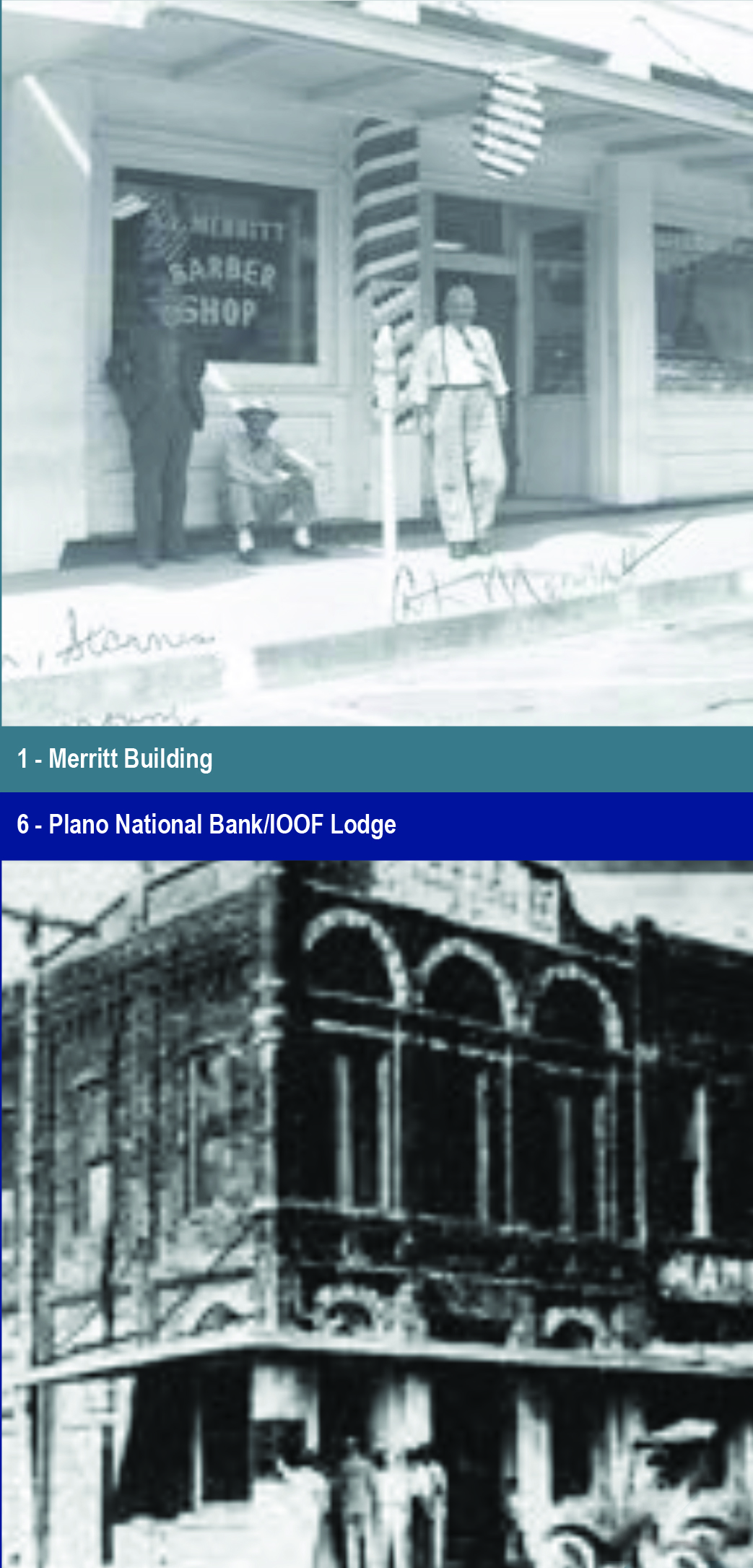
1. Merritt Building 1023 E 15th Street
(1916) This building is typical of those built after the downtown fi res and is characteristic of the development in Plano in the early 20th century. During Trades Days, the Merritt Barber Shop, with a bath tub in back, stayed open until midnight due to the heavy trade and business.
2. Fred Schimelpfenig Building 1017 E 15th Street
The building was built in 1884 by the Sanger Brothers and was made into the most prosperous dry goods store in Plano by Frederick Schimelpfenig. Schimelpfenig ran the store until the fi re of 1895. It has since been a dry goods store, sportswear store, and other businesses.
3. Bagwill-Sherrill Building 1015 E 15th Street
(c.1895) This building has served as a general store, drug store, saloon, grocery, bank, newspaper office, hobby shop, and office building. Over the years, food, clothing, supplies for home and farm work, medicine for sick children, lively conversation, and political discussions were found here. The newspaper office was a male enclave where the farmers could gather to escape the rigors of scratching out a living on the vast, untamed prairie.
4. Mathews General Store 1013 E 15th Street
One of several brick building erected after the fire in 1895, it was home to Mathews Department Store from 1906 until 1947. It is one of Plano’s few 19th-century stores in continuous commercial operation.
5. W.D. McFarlin Building 1011 E 15th Street
W.D. McFarlin rebuilt this brick building in 1895 after the original building was destroyed by fire. The building has served as a grocery store, a dry goods store, drug store, and other businesses.
6. Plano National Bank/IOOF Lodge 1001 E 15th Street
(c. 1896) The IOOF Lodge built the original two story building at this location and occupied the second floor. The first floor was leased to the Murray Saloon until 1887, when it was sold to Plano National Bank. After the downtown fire of 1895, the current brick structure was constructed. In February 1920, the bank was robbed, resulting in the death of police offi cer G. W. Rye. The facade was redone in the Art Deco style in 1936.
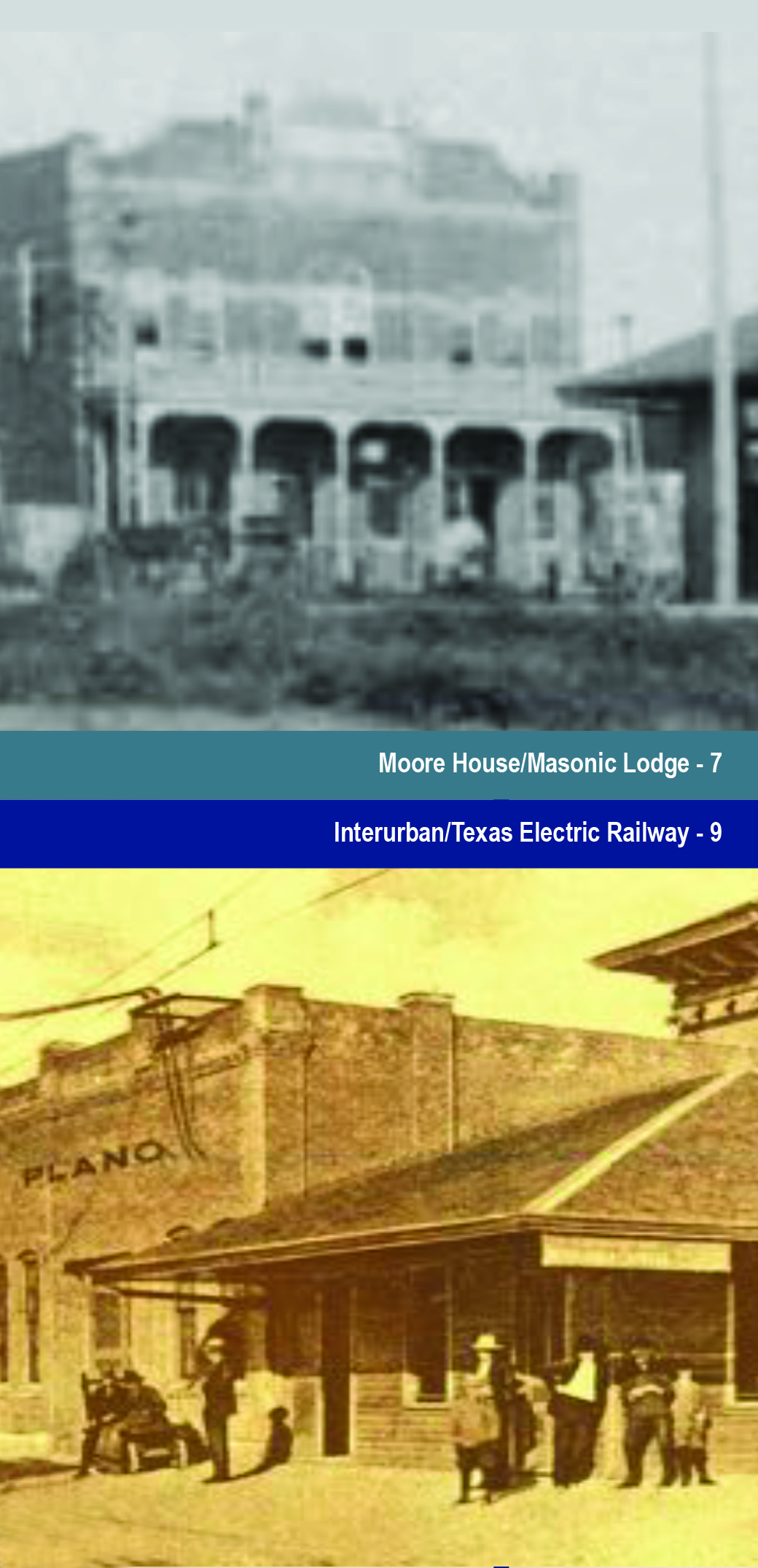
7. Moore House/Masonic Lodge 1414 J Avenue
(1896) Originally built as the Moore House Hotel, a hotel that catered to rail travelers on the Houston and Texas Central Railroad, the building was later named the Commercial Hotel before it was purchased by the Plano Masonic Lodge for use as a lodge and meeting place of civic organizations. This two-story brick commercial structure was altered with a stucco covering and the porch was removed in 1925.
8. H&TC Railroad Tracks 15th Street & DART Rail
Nothing changed Plano like the coming of the Houston & Texas Central Railroad, which began operation in 1872. Today, DART’s W.D. McFarlin Building Moore House/Masonic Lodge – 7 Old Plano Texas High School Interurban/Texas Electric Railway – 9 light rail service to Dallas keeps the tracks an important part of Downtown Plano.
9. Plano Station, Texas Electric Railway 901 E 15th Street
Built in 1908 by the Texas Traction Company (Texas Electric Railway after a merger in 1917), this station served passengers and freight customers of the company’s North Texas routes. The wood frame passenger depot and the attached brick freight/ electric transformer section remained in use until 1948, when the rail system declined in favor of automobile travel. Today the only remaining electric substation from the line houses the museum where you can learn about the electric trains that provided both urban and rural families with the ability to travel safely and conveniently from farm to city.
10. Streets of Historic Plano 901 E 15th St
In 1948 the streets of downtown Plano were renamed in preparation of door-to-door postal service. Among the changes, Main Street became K Avenue and Mechanic Street became 15th Street.
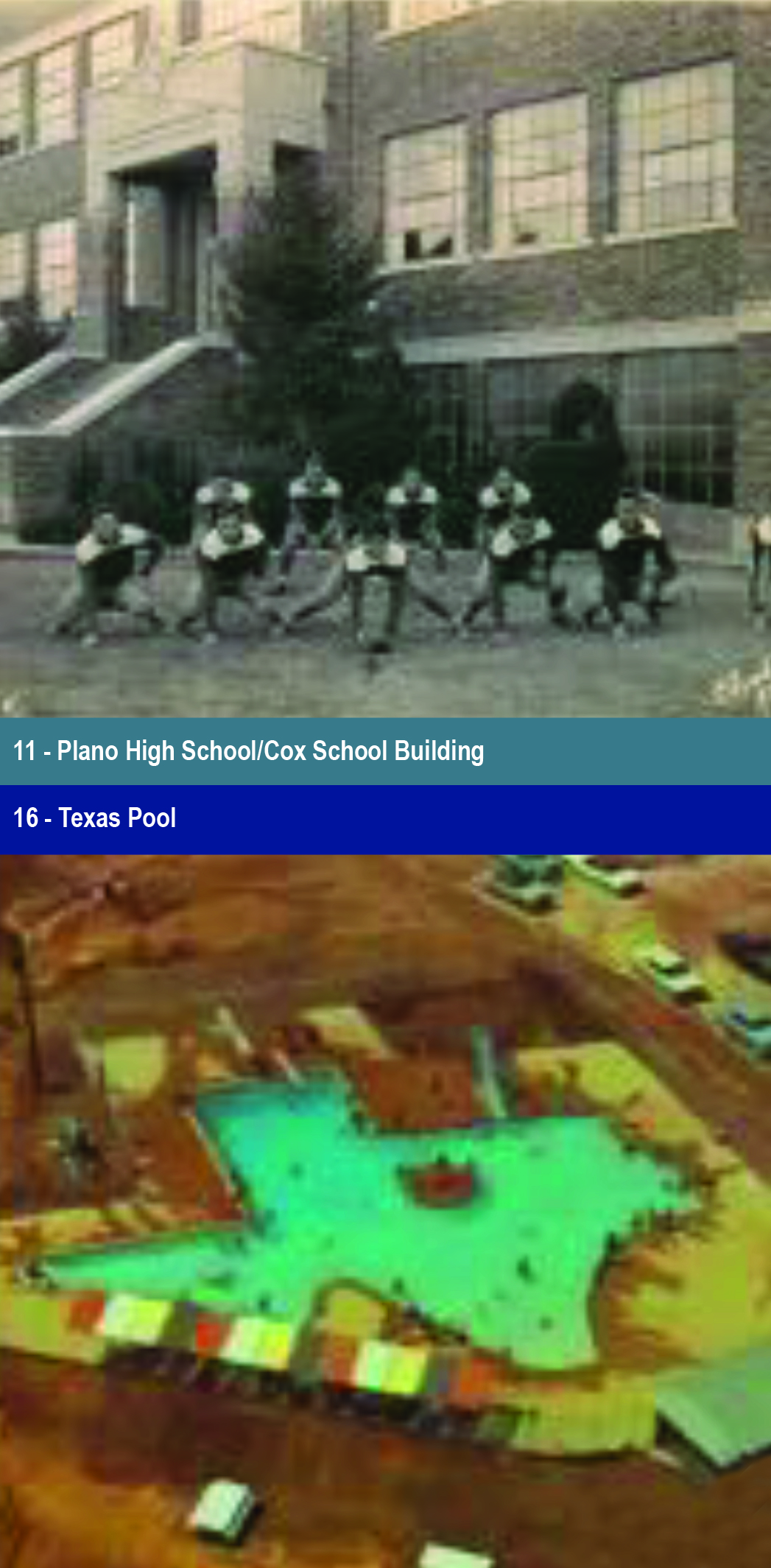
11. Plano High School/Cox School Building 1517 H Avenue
(1923) The style of this building has been dubbed Prairie Beaux Arts. The two-story brick structure with a raised basement, central double loaded corridor and stair towers at each end was renovated in 2005 and is currently used as training rooms, offi ces and rehearsal halls. The entire school district (K-12) was housed in this facility until the early 1950s.
12. Douglass Community Mural 1099 12th Place
Dedicated in 2007 as part of Plano’s Juneteenth celebrations, this mural illustrates the past, present, and future of the Douglass Community. Named after well-known writer, orator, and abolitionist Frederick Douglass, the Douglass Community was home to many of the fi rst African Americans to move to Plano.
13. Rice Field Site SWC of G Avenue & 18th Street
This site was the home of the Plano Wildcats football team from 1925 to 1963. Rice Field was also the home to Plano’s AfricanAmerican High School team, the Panthers. The fi eld boasted such amenities as seats for 1,000 spectators, fl ushing toilets, and a small press box.
14. White Rock Road Legacy Trail (Children’s Medical Center)
Chalky deposits, formed by the shells of ancient marine life, became the rocky base of this natural trail following the shores of a shallow inland sea. Used by mammoths, bison, Spanish explorers, wild cattle, native tribes, and then pioneer settlers of Texas, it was for centuries a reliable path for food, shelter, and water.
15. Shawnee Trail Legacy Trail
(N of W Spring Creek Pkwy) Following an existing Native American trail from the Red River to Austin, the Shawnee Trail was commissioned by the Republic of Texas to protect new settlers and open the area to trade. It later served as a primary route for cowboys driving cattle from South Texas to markets in the north. Today, Preston Road, roughly follows the route of the original Shawnee Trail.
16. Texas Pool 901 Springbrook Drive
Opened to the public in 1961, this 168,000 gallon pool in the shape of Texas serves as a symbol of Plano’s rapid growth in the second half of the 20th century. Generations of Texans have learned to swim, shared summers, and created memories at the Texas Pool.
17. Muncey Incident Oak Point Park Trail (W of Emerald Coast Dr)
At this location in 1844, the slain bodies of McBain Jameson and several members of the Muncey Family were found by William Rice and Leonard Searcy. After finding the bodies, the men sped off to find their sons who were hunting nearby. Young Searcy was found safe, but Rice had been killed. A state historic marker describing the incident is located on the east side of the Collin College Spring Creek Campus.
18. Oak Point Park 5901 Los Rios Blvd
Five wayside signs can be found along the trails in the Oak Point Park & Nature Preserve that detail the geological & ecological history of the area, early farming and farming techniques, and birds of Oak Point Park.
19. Wildcat Stadium (Williams Field) 1717 17th Street
Wildcat Stadium was the home of the Plano High School football team from 1964 to 1975. During their time on this field, the school won its first state championship in 1965, with additional championships in 1967 and 1971.
Homes
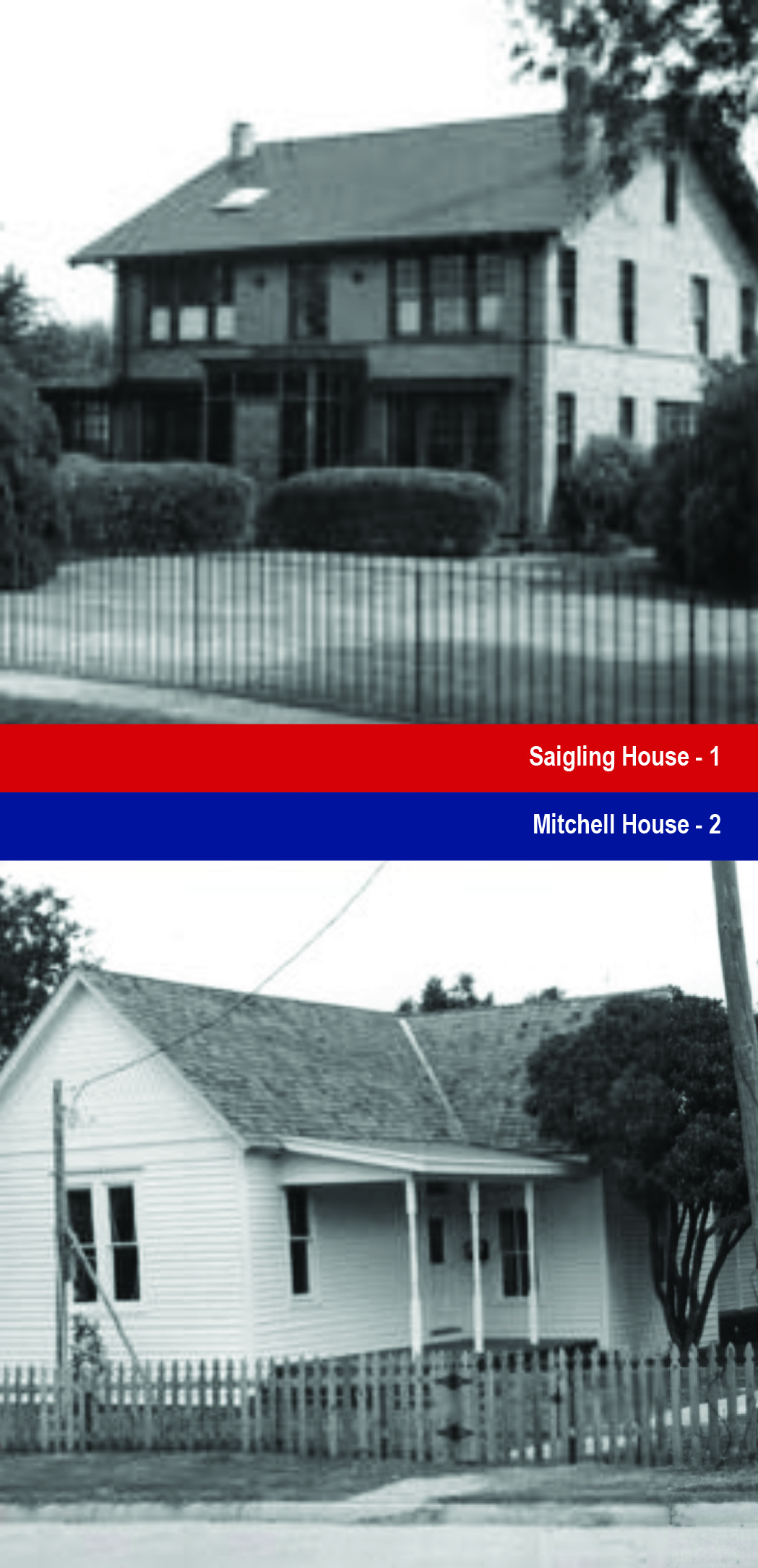
1. Saigling House 902 E 16th Street
(1917) Charles Frederick Saigling, a prominent businessman and civic leader, moved his family to Plano in 1881 and established the Saigling Lumber Company and Saigling Milling Company. He later built the fi rst sidewalk in Plano, constructed of lumber, along Mechanic and Main Streets (now E 15th Street and K Avenue).
2. Mitchell House 609 E 16th Street
(c. 1891) Simple frame homes such as this one were common to early Plano. The house has been owned by the Mitchell Family since approximately 1933. Located on the east side of the property is a small building believed to have been used as a blacksmith’s shop.
3. S.B. Wyatt House 807 E 16th Street
(c. 1910) This Craftsman style bungalow was built by one of Plano’s early doctors, S.B. Wyatt. The front porch columns are designed in a unique fashion with a stacked wood pattern. The low pitched roof, broad overhanging eaves and numerous windows made this housing style particularly well adapted to hot Texas summers in the days prior to air conditioning.
4. Aldridge House 1615 H Avenue
(1907) This Prairie style house features a horizontal orientations, square columns, and porte cochere, which are holdovers from the Craftsman style. Charles Aldridge was an important landowner, cotton buyer, school board member, and representative of the Guaranty State Bank. He perfected a special variety of cotton that was widely planted throughout the Southwest. The Aldridge family is reported to have been the fi rst with an electric “icebox.”
5. Will Schimelpfenig House 900 17th Street
(c. 1901) This vernacular Queen Anne style house with small “clerestory” windows in the half story and square stair balusters was altered in the 1970s when the original porches were replaced by one wraparound porch. The home was used as a boarding house for single, female school teachers who taught at the nearby Plano School. Will Schimelpfenig’s future wife, Effie, lived in the house and he lived next door. After their marriage, they lived in his childhood home until 1921, when they bought this home, living here until the early 1970s. Will’s father, John W., and his uncle, Fred, were early settlers from KY. The brothers developed and built houses in this neighborhood.
6. Schimelpfenig-Dudley-O’Neal House 906 17th Street
(c. 1893) This one and one-half story Folk Victorian farmhouse was built by Fred Schimelpfenig. Fred’s brother, John W., and his wife, Johanna, reared their children in the house. Descendants of early Plano settlers, the Dudley Family purchased the house in 1959. On the brink of demolition in 2001, the O’Neal Family rescued and renovated the house. The front door and colored glass at the east and west windows are original. The house was expanded by a large rear addition.
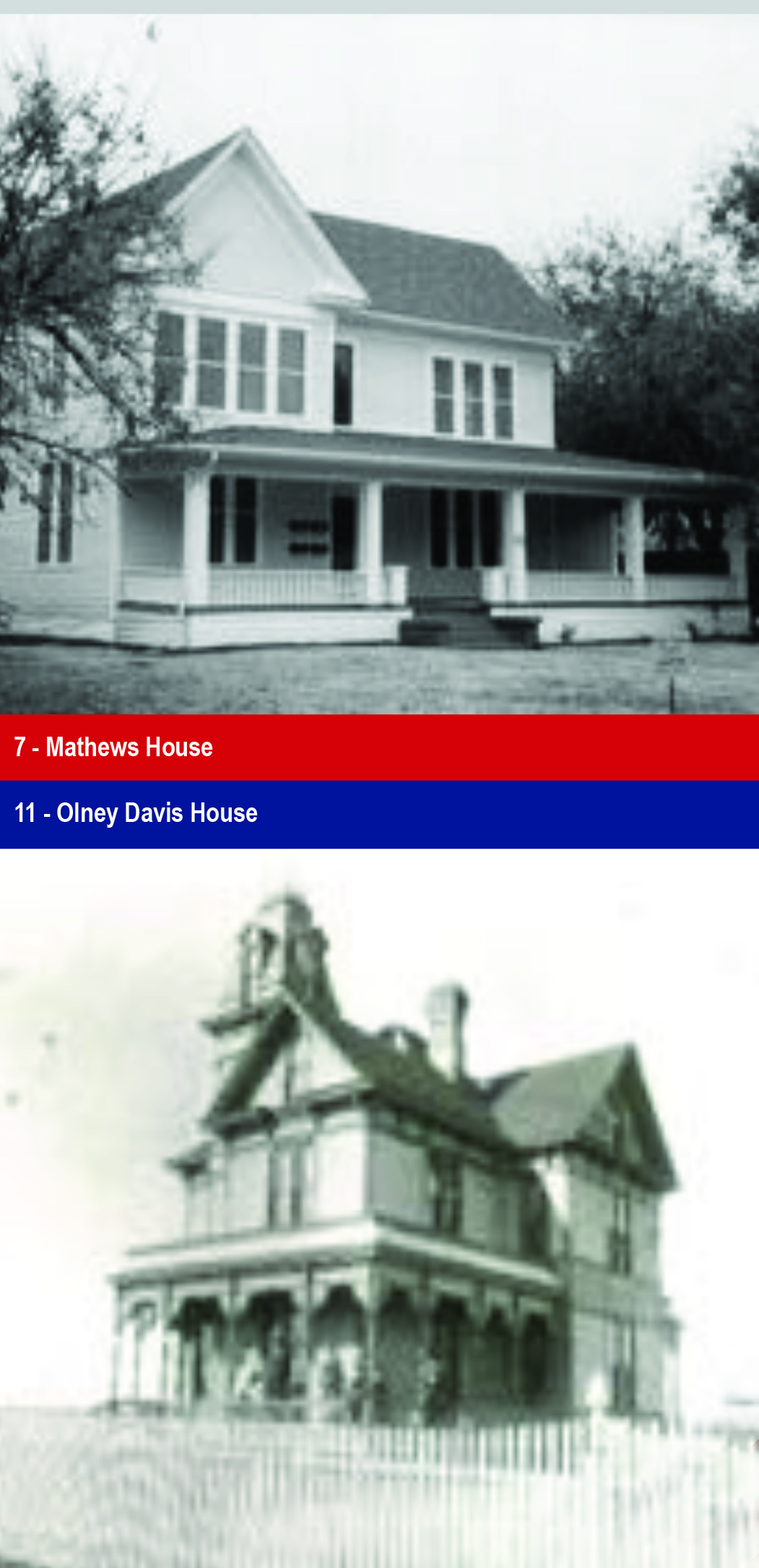
7. S.J. Mathews House 901 17th Street
(c. 1888) This vernacular style farmhouse is probably the oldest in the neighborhood. The trim on the side of the building suggest more elaborate original ornamentation. The porch was changed between 1910 and 1929. Mr. Mathews ran a general store in downtown Plano from 1895 to 1947. His wife was a milliner and sold her creation in her husband’s store.
8. Lamm House 1709 H AvenuE
(c. 1893) This Queen Anne cottage boasts elaborate sunbursts of the front gable and above the front door, typical features of homes of this era. Auguste Lamm was a public weigher, day clerk for H&TC RR, and railroad agent for the Southern Pacific.
9. R.A. Davis House 906 18th Street
(1913) R.A. Davis was the son of Olney and Effie Matthews Davis, who lived across the street. His father gave him the Colonial Revival house, where he and his family lived until 1953. R.A. was involved with the banking business throughout his life, serving as president of Farmer’s State Bank. He was also a partner in the Farmer’s Gin Company of Plano and served on the City Council.
10. Mary Schimelpfenig House 914 18th Street
(c. 1890) Built as rental property by Fred Schimelpfenig, who later sold the home to his daughter, this house is Folk Victorian style. Mr. Schimelpfenig owned a prosperous dry goods store, was involved in the lumber business, developed and built homes, and was involved in the cotton trade. He also served as mayor. Decorative bracketing under the overhang is a simplified Queen Anne form.
11. Olney Davis House 901 18th Street
(1890) This Queen Anne style house originally featured a tower and elaborate “gingerbread” millwork. Around 1915, the house was renovated to stay in fashion, and the tower and spindle work were removed. The classic style columns and pediment on the porch were then added. Due to a slight ground swell, the property was referred to as the “House on the Hill,” reflective of the leisurely way of life and gracious living at its best. Olney Davis was a prominent businessman, civic leader and mayor, and the first president of the Board of Trustees for the Plano School System.
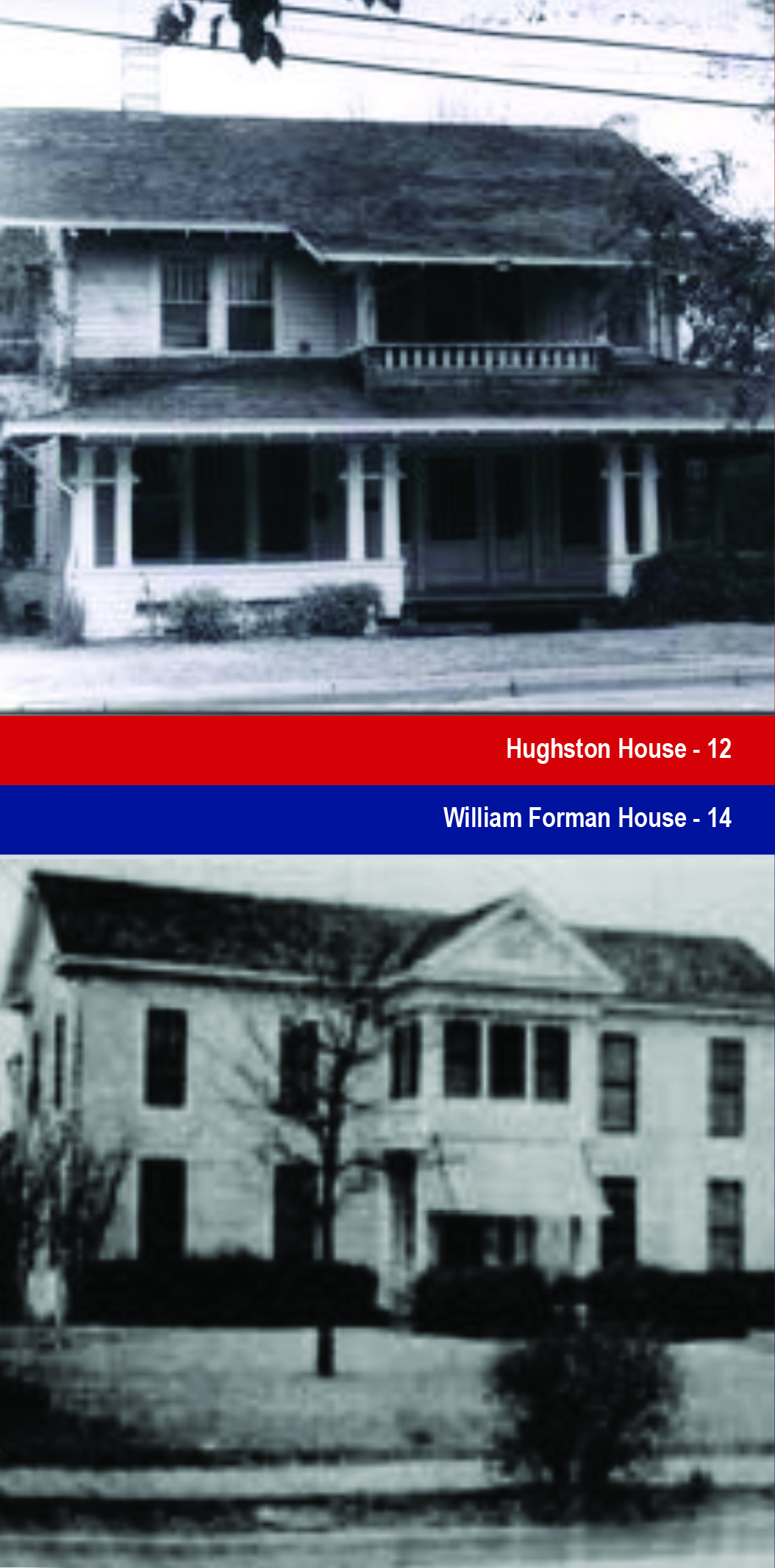
12. Hughston House 909 18th Street
(c. 1890 / 1915) Fred Schimelpfenig built the rear portion of this house as a rental property. In 1915, Arch Hughston purchased the house and lived there with his wife Emma and their six children. The Hughstons added the front section of the house and porch, changing the style of the house from Queen Anne to Prairie style.
13. Wall-Robbins House 1813 K Avenue
(c. 1898) “Col.” James Edgar Wall purchased this lot in 1898 and built a home for his new wife. The Queen Anne style Victorian home was considered the fi nest example of a residence in Plano Hughston House – 12 William Forman House – 14 at that time, containing fi ve fi replaces, stained glass window, large pocket doors and 11-foot ceilings with intricate Victorian era details. Cattle buyer W. Jeff Robbins purchased the house in 1908, and the home remained in his family until the 1950s.
14. Forman House 1617 K Avenue
(1867) Joe and Elizabeth Forman built this Greek Revival style house, which is the one of the oldest surviving homes in Plano. The industrious Forman family engaged in farming, cattle, and other business pursuits. He served in the Confederate Army and was elected one of Plano’s earliest mayors in 1877. The various family enterprises produced products to sell for cash changing the Plano economic base from an early barter system.
15. Little Carlisle House 1611 K Avenue
(1925) This Tudor style cottage was built by Abernathy and Son for Willie Glynn and Minalee Carlisle and their children, Bill and Jane. Mr. Carlisle was Plano’s longest serving postmaster from 1935-1968 and part owner of Plano Grocery Company. The family was active in the Presbyterian Church. The back yard was filled with fruit, vegetable, and flower gardens. Mr. Carlisle passed away in 1970, and Mrs. Carlisle stayed in the house until 1991.
16. Carpenter House 1211 E 16th Street
(1898) This two and one-half story Queen Anne style home was built for Henry Overaker, who was active in the cotton industry, owned a lumber yard, and served as the eighth postmaster for Plano. The home later sold to Gipson E. Carpenter, son of two of Plano’s earliest settlers. He served as city attorney, council member, and mayor.
17. McCall-Skaggs House 1704 N Place
(1959) The site is significant to the history of Plano due to identification with its first two owners, David McCall, Jr. and Mary Alice Skaggs. David McCall, Jr. was the mayor of Plano when the house was built in 1959 and served as the first principal of Plano Elementary School (now Mendenhall Elementary). McCall sold the home in July 1986 to Plano ISD teacher Mary Alice Skaggs, who was the first woman educator in Plano to receive a Master’s degree. In 1986, a new elementary school was named in her honor.
18. Schell House 1210 E 16th Street
(1937) Originally located on 14th Street and relocated to the 21 Roller House 1413 E 15th Street (1901) This Queen Anne style house with three-story tower present site, the house was built by A.R. Schell, Jr. from house plans found in Holland’s Magazine, a Dallas publication. He served the longest consecutive term as mayor from 1932-1948. His efforts resulted in improved public roads, new businesses brought to town, regulation of utilities and establishment of the Parks Board to enhance community life.
19. Hood House 1211 E 15th Street
(1892) The one and one-half story Folk Victorian style house was built by Dr. Thomas L. Hood, Jr. on a foundation of bois d’arc stumps with the original well situated on the east side. Various family members have been prominent in Plano business and civic circles from the late 1800s to the early 1900s.
20. Carlisle House 1407 E 15th Street
(1912) The Carlisle House is a two-story Prairie style home built by Robert Abernathy. The home was the former residence of H.B. Carlisle and family, a local grocer and friend of Sam Rayburn. He was willing to sell on credit and be reimbursed twice a year when the crops came in. His grocery store was a favorite gathering place with farmers to discuss the weather, crops, and news of the day.
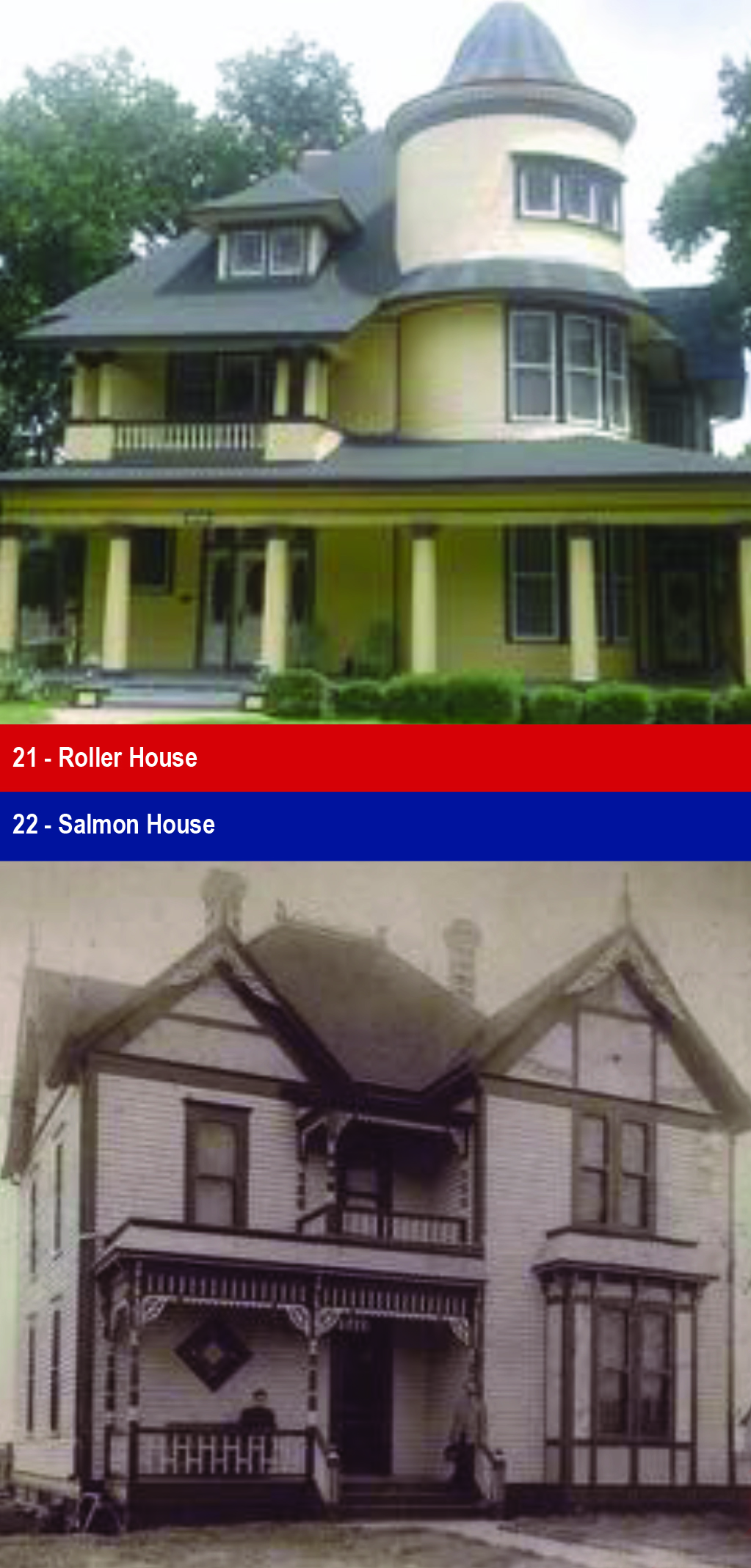
21. Roller House 1413 E 15th Street
This Queen Anne style house with three-story tower has a wide roof overhang, a one-story porch and round fluted columns. The home was built by A.G. McAdams, a local architect and lumber merchant. In 1909, E.L. Roller purchased the house and added the columns to the front porch. Mr. Roller was one of Plano’s early civic leaders and active in the social life of Plano.
22. Salmon House 1414 E 15th Street
(c. 1898) This house was built by the Salmon Family, who owned a large farm east of Plano and were related to the Haggard Family. A second home in town was typical for wealthy farmers to be close to school, business, and church. The home is an exemplary Queen Anne with elaborate surface decoration on the gables, fi sh scale pattern, and radiating sunburst.
23. Arch Weatherford House 1410 E 15th Street
(1915) In the early 20th century, Arch Weathorford’s small watch and clock repair business grew into A. Weatherford Jeweler. This store offered linens, diamonds, watches, crystal, china, and was dedicated to personal service. Reported to be the oldest in Plano to remain within a family, the business was an integral part of Plano’s history. Mr. Weatherford was a school board member, large stock holder in Farmers and Merchants National Bank and officer for the Plano Cooperative Gin Co.
24. Thornton House 900 13th Street
(c. 1900) John Thornton was a prominent African-American citizen, sharecropper, farmer, and real estate investor. He bought the homestead in 1909 and the home remained in his family for approximately 80 years. The home a prime example of the vernacular farm dwelling construction commonly used in North Texas in the 19th century. Research indicates this house has a direct link to the growth and development of the spiritual center of Plano’s African-American community.
25. Wells Homestead 3921 Coit Road
(c. 1893) This vernacular farmhouse has always remained in the family. In 1871, Mr. William Henry Lafayette Wells came to Plano from Virginia after serving in the Civil War. He had fought for the Confederacy and remained a staunch supporter of the cause until his death in 1939 at age 98. For his first job, he helped drive mules, saving up enough money to purchase his homestead in 1874.
26. Ammie Wilson House 1900 W 15th Street
(1891) Built by Hunter Farrell of wood on bois d’arc blocks and framed of pine roof rafters and square nails, this elaborate Folk Victorian house is covered with 8-inch beveled clapboard siding and has six steep-pitched gables. Mr. Farrell’s daughter, Ammie Wilson, became the most successful and renowned pure-bred sheep breeder and show woman in the United States. Many of the original outbuildings on the farmstead are still on site and open for tours. The Heritage Farmstead Museum is a reminder of the agrarian roots of the community.
Sidewalk Markers
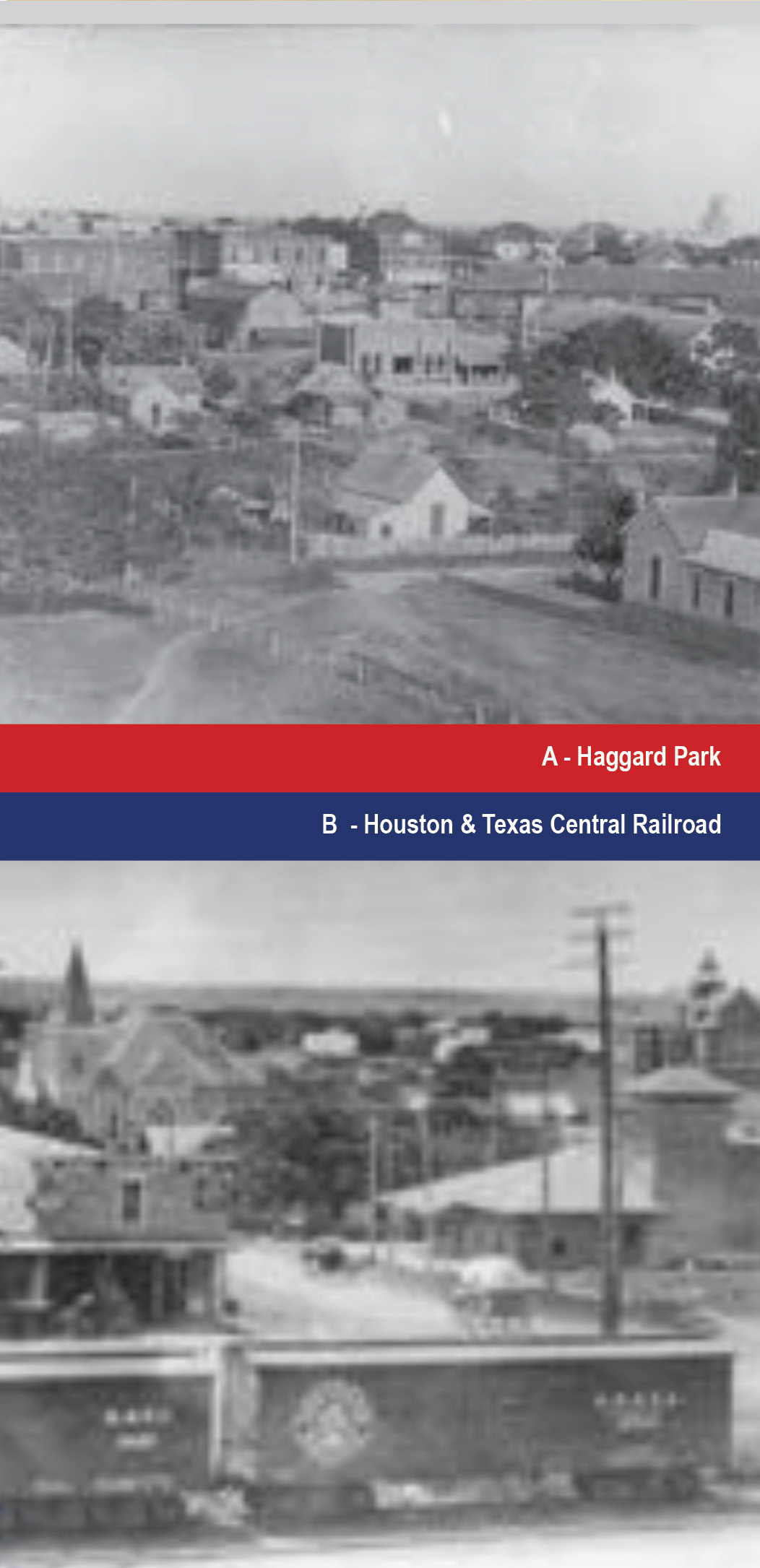
A. Haggard Park
Prior to the 1920s, this area contained several homes and a lumber mill. Present day revitalization of the downtown area has increased the need for a community gathering place, bringing to this site renewed energy in the form of musical venues, seasonal celebrations, numerous weddings, and public art. The heartbeat of our pioneer families resonates strongly in the city’s second oldest park.
B. Houston and Texas Central Railroad
Bonuses offered by the cities of Dallas, McKinney, and Sherman assured that the H&TC Railroad would pass through Plano due to the town’s location. Being a much smaller and less prosperous community, Plano could not afford to offer an enticement. In 1878, Sam Bass and his gang staged the first major train robbery on this line, which took place in Allen, TX on the H&TC Railroad.
C. First Municipal Library
Gladys Harrington learned that Plano did not have a public library. She undertook the effort to establish a library assisted by members of the Federation of Church Women. Since the opening of the Harrington Library in 1969, the public system has expanded to a total of five locations. Gladys Harrington will long be remembered for her dedication to civic causes, especially those reflecting education and arts.
D. Plano’s Opera Houses
In addition to the opera house at this site, another hall was located on the second fl oor of the Commercial Hotel on the east side of the “jockey lot” where the old Moore House had been. Events such as parties, dinners, skating and other functions were some of the more frequent events held in these community gathering places.
E. Biggerstaff Flowers
The garden on this site is a fitting tribute to the memory of an esteemed citizen who did his utmost to help beautify Plano as well as to guide the growth and development of his community.
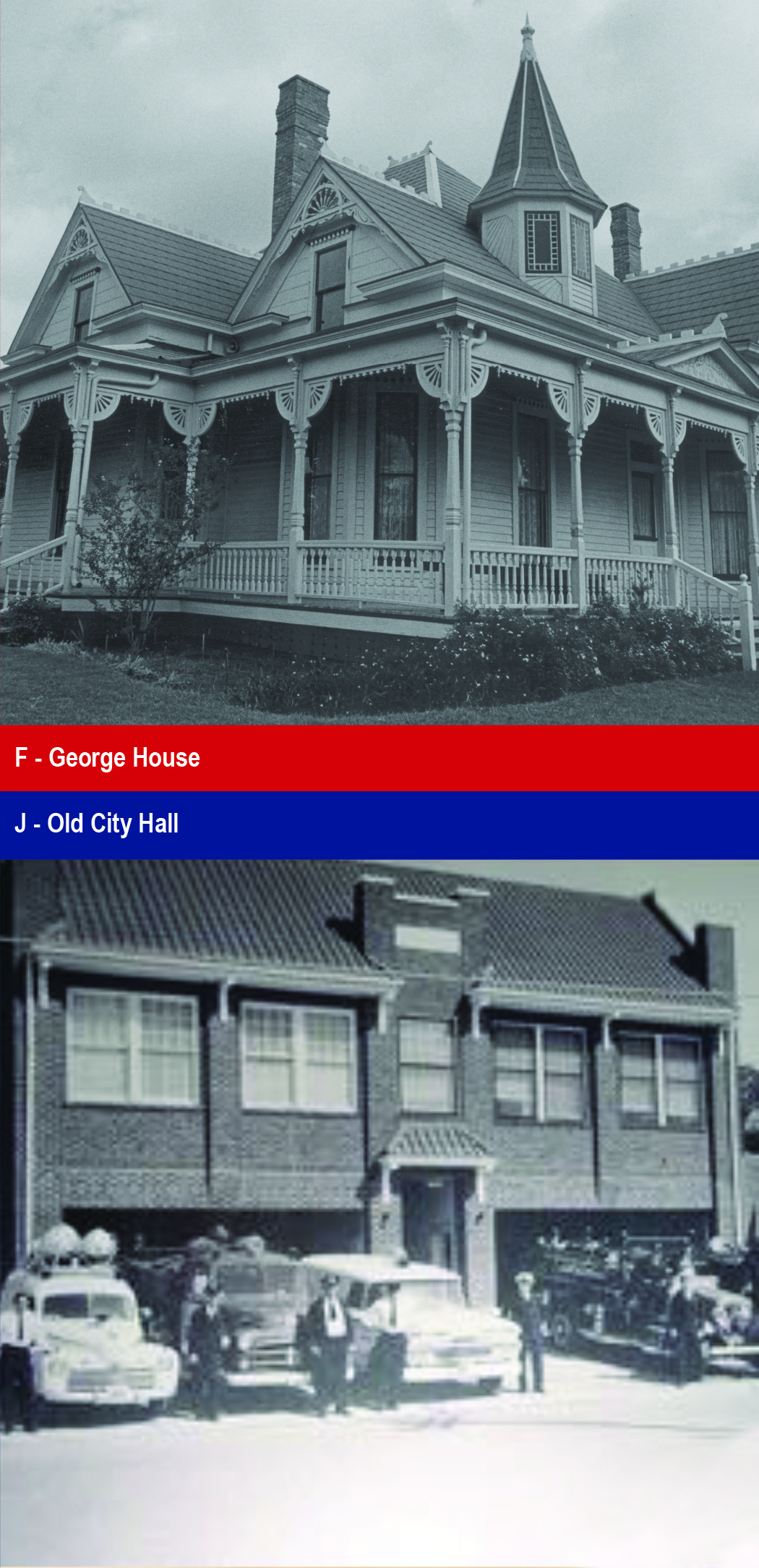
F. George House
The threat of demolition of this structure gave rise to the first major preservation efforts in the city. While local residents were unable to keep the George House within Plano, later efforts were re-channeled to save the Ammie Wilson house, at the Heritage Farmstead Museum. This beautiful Victorian home was relocated to Old City Park, Dallas.
G. Klepper’s Wagon Yard
The heart of the young business community originated along this road. In 1871, Plano’s town population totaled 155 residents. Main Street, now known as Avenue K, continued to be the primary route used until North Central Expressway was built in the 1960s.
H. Bagwill Home
Bagwill instituted coverage of significant local information and never tried to interpret national or international news. He promoted the City of Plano by encouraging “community service” by businesses and organizations. His daughter, Louise Bagwill Sherrill, continued in her father’s footsteps becoming one of the first women newspaper owners in Texas.
I. Plano’s First Hospital
Dr. Slater Benjamin Wyatt was a member of the fi rst graduation class in 1905 from Baylor Medical University in Dallas. He practiced medicine for 48 years before his death in 1973.
J. Old City Hall
Plano was incorporated as a town on June 2, 1873, and was chartered as a general law city. In 1961, Plano adopted home rule making it possible for the City to annex land to grow in size. When this building was replaced in 1965 by the new Municipal Center to the north, John Connolly dedicated the building. He was the first Texas governor to visit Plano.
K. Fire Wells
Plano’s first fire department on record was a bucket brigade called the Eclipse Fire Company, begun in June 1887. Later that year the city purchased a hand drawn hook and ladder wagon made by the O. Davis Hook and Ladder Co. By 1915, the fi re department changed from horse drawn vehicles to motorized equipment.
L. McCall Plaza
Mr. McCall served as principal of Mendenhall Elementary School from 1952-1955. Plano’s growth was greatly influenced by his devoted service.
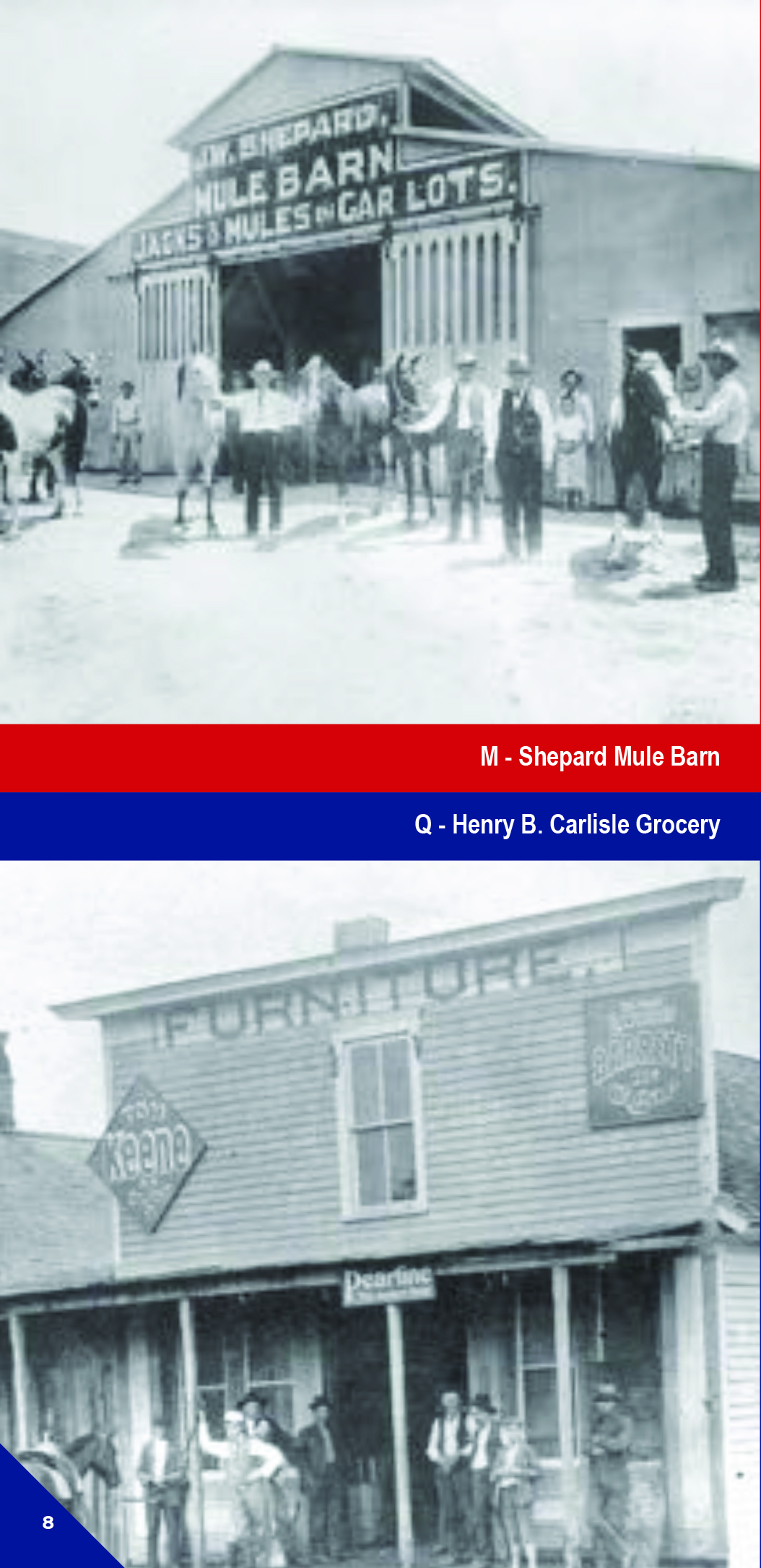
M. Shepard Mule Barn
This barn was the center of activity on second Monday Trades Days. People would gather in the “jockey yard” to bid on mules and “jockey” prices. In addition to his raising mules, J.W. Shepard was connected with cotton gins, cotton oil mills and flour mills. The Shepard ranch was located west of Preston Road, near Park Blvd. The Dallas Morning News wrote “Probably no other man has ever done so much for Plano and South Collin (County), furnished work to more people and fed more hungry less fortunate people than has J.W. Shepard.”
N. Legend of Mammoth Jack
A mule is a cross between a donkey and a horse to produce the best traits of both animals. Mules are very intelligent animals and are not really stubborn, but they will not put themselves in danger. They have more stamina and can carry more weight than a horse of equal size which made them better suited for improved farming machinery of old. One particular aspect where the mule outshines the horse is high-jumping.
O. C.F. Saigling Lumber Company
Charles Frederick Saigling operated a business selling lumber and other building materials along the railroad. The business was sold to J. T. Elliot in 1895.
P. Weld & Neville Cotton Gin
In 1899, Martine L. and Irene Kelly erected a cotton gin in this location. At the gin, cotton was pressed into bales for ease of transport. Ownership of the cotton gin changed several times before the business closed in the 1930’s.
Q. Henry B. Carlisle Grocery
In 1889, Henry B. and J.M. Carlisle established a business known as the Plano Grocery Company near this location. The business grew to become the largest grocery store in Collin County and was a favorite gathering place for farmers. The store carried grain, hay, cotton, seed, and groceries. The poor economic conditions of the great depression forced the business to close in the 1930s.
R. J.T. Stark Grain Warehouse
James Thomas Stark was a retail grain dealer and president of the Stark Grain Elevator Company. His business was the first to bring electricity to Plano in 1899.
S. H&TC Railroad Depot
The Houston and Texas Central Railroad Company established a restaurant and the Durant Hotel, which fronted west facing the depot. All passenger trains stopped here, so people could have a meal in the restaurant. The depot closed in 1932 and later served as the Plano Implement Company and the Plano Lumber Yard.
T. Alex Schell III Way
A.R. “Alex” Schell III was a longtime Plano resident and public servant. Mr. Schell served two terms with the Plano City Council, acted as Mayor Pro Tem, and represented the city of the North Texas Municipal Water District Board of Directors from 1964 until 2010, the longest time of service for any member city. He owned and operated the A.R. Shell & Son Insurance Agency in the Schell Building at 1001 E 15th Street. The portion of J Avenue along the side building was renamed to “Alex Schell Way” in 2014.
U. Civic Auditorium
Subscriptions pledged by Plano citizens made possible the erection of the original auditorium. The present building on this site replaced the Civic Auditorium and was erected as a Works Progress Administration project in 1938. Serving fi rst as the school gymnasium and auditorium, offi ces for the Plano Independent School District were later housed here. In 2002, the building was renovated and converted to a community theatre. The exterior was restored to the 1938 design.
V. Plano High School
In 1899, the school was separated from the City, and this was the beginning of the fi rst public school in Plano under the management of an offi cial Board of Education. Following fi res of wood frame buildings in 1894 and 1903, the Plano Public School opened in about 1903 in a red brick, three-story building in the Spanish architectural style. In 1924, the “Old Spanish School” was replaced with the current structure as the enrollment grew.
Cemeteries
1. Baccus Cemetery NW Corner of Legacy Drive & Bishop
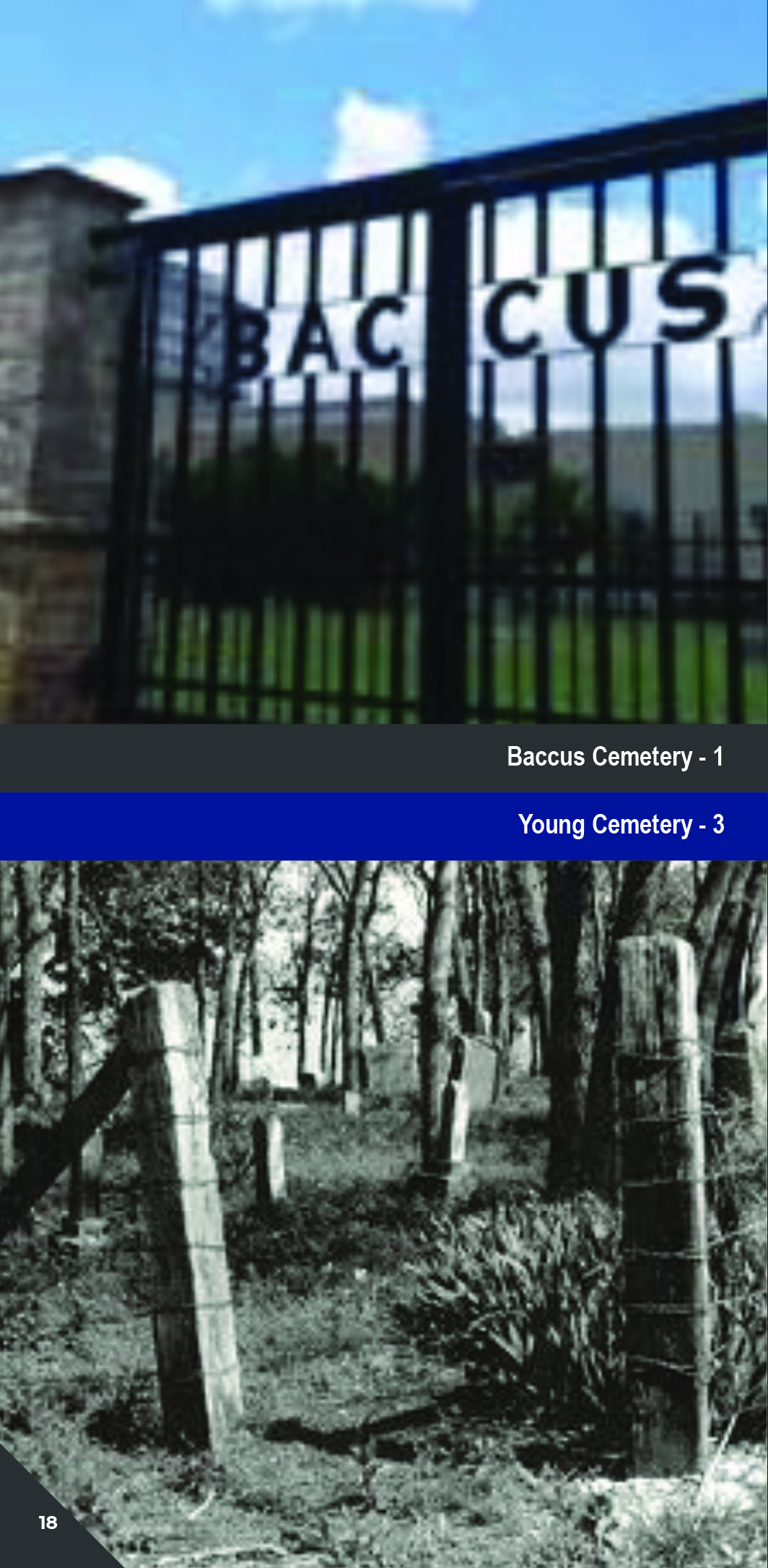
This cemetery was originally known as Cook Cemetery, for Henry Cook, a veteran of the War of 1812, who buried his son at this location on January 13, 1847. His marker is the earliest known marked burial in Plano. His daughter, Rachel Cook Baccus, deeded the burial ground to his heirs in 1878 and later donated adjoining land for the Baccus Christian Church Sanctuary. The cemetery is unique in that it is now surrounded by the high-rise offices and shopping of the Shops at Legacy.
2. Collinsworth Cemetery 3103 Vermillion Drive
William Collinsworth arrived by train from Tennessee in the 1870’s to establish a permanent residence. He was joined later by his parents, Farwock M. Collinsworth and Lucy Ann Rowlett, and seven siblings. In 1895, a smallpox outbreak originated from the Collinsworth home, which led to a quarantine of the area by Plano officials. The cemetery was established at that time for those affected by the epidemic. Although only six headstones are visible today, reports cite as many as thirty Collinsworth family members may be buried here.
3. Young Cemetery 10200 Independence Parkway
Sam and Patience Cornell Young came to Collin County from Illinois in 1842 and founded on a school on their property. This cemetery was established when Patience died in 1847, whose grave is the second oldest known gravesite in Plano. There are 51 known graves in the cemetery, including Thomas Finley, a veteran of the War of 1812. The Young House was relocated to the Heritage Farmstead Museum on 1900 W. 15th Street.
4. Rowlett Creek Cemetery Rowlett Cemetery Road
After meeting in homes and outdoors, seven charter members organized the Wilson Creek Church of United Baptists in 1848, which was eventually renamed Rowlett Creek Baptist Church in 1852. The church is believed to be the earliest Baptist church in Collin County and influential in establishing many early churches. The earliest marked grave in the cemetery is that of pioneer Alfred Harrington in 1862.
5. Bethany Cemetery Custer Rd, north of Legacy Drive
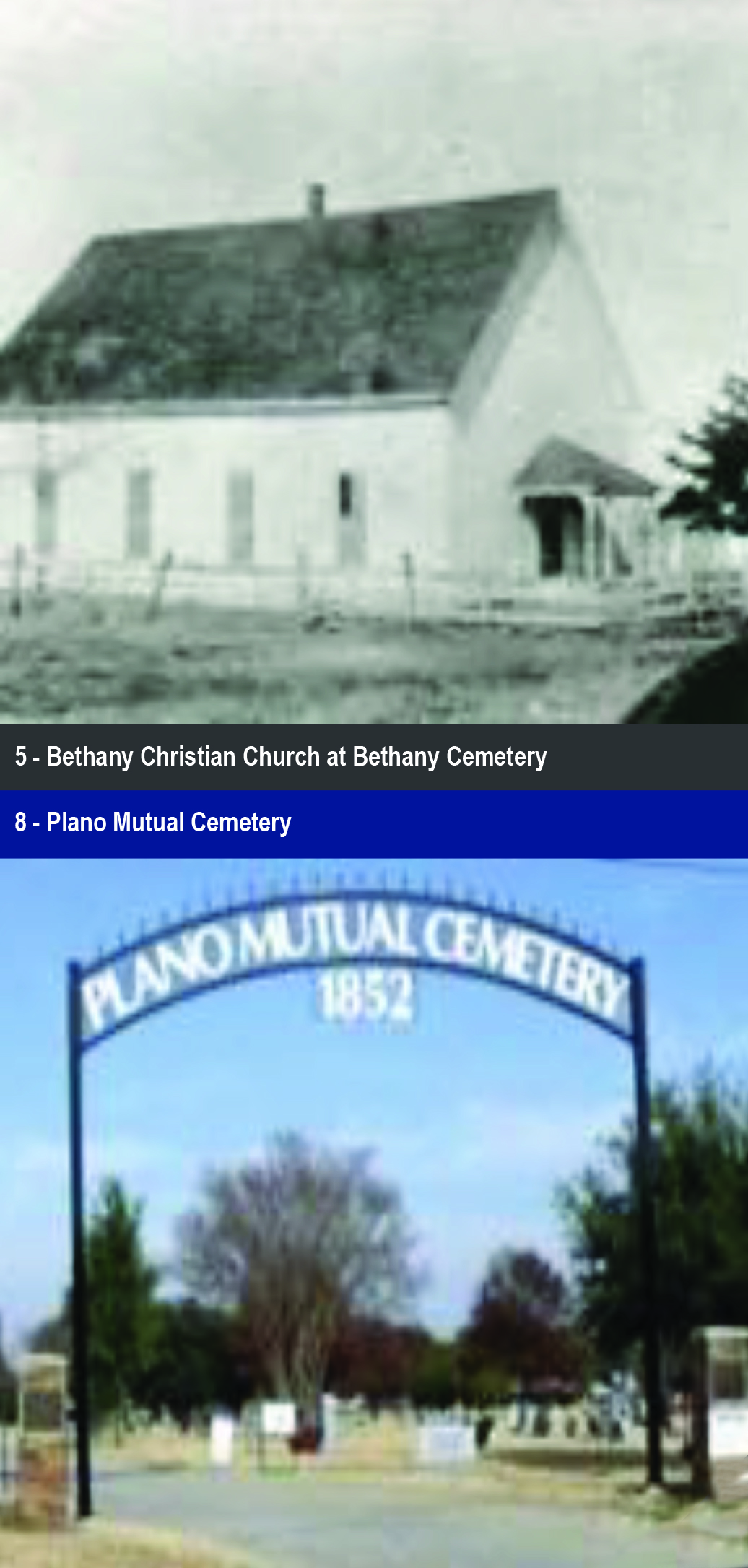
This cemetery was established in 1887, just north of a rural church and school site begun by families buried here. As access to downtown Plano improved in the 1930’s, attendance at the rural church declined and the buildings were eventually demolished due to lack of use. The cemetery remains and now contains the iconic MISSIONS gatekeeper, restored and relocated to this site in 2014.
6. Leach-Thomas-Perrin Cemetery 7025 Pensacola Drive
The site of the Leach-Thomas Cemetery was once part of the Jeremiah Muncey survey. After the Muncey family was killed in an Indian raid, the site was obtained by William Perrin, who established a family cemetery. Mr. Perrin’s grand-daughter married Joseph William Baines, who together are the grandparents of President Lyndon Baines Johnson.
7. Bowman Cemetery 2846 Oak Grove Drive
Bowman Cemetery was established in 1868, when John D. Bowman buried his daughter, Julia Ann Bowman Russell. The cemetery contains two fenced sections, one for the Bowman family and the other for members of the Brown family, who were related through marriage. Outside of the fenced areas are marked and unmarked graves of early African American and European American residents of Plano. Also buried in the cemetery is Dr. Henry Dye, who is credited with naming the city of Plano.
8. Plano Mutual Cemetery NW Corner of Jupiter Road & 18th Street
This cemetery traces back to 1852, when the death of Dr. Lillie prompted several of Plano’s early pioneer families to decide the location of a graveyard site. They chose a site where the properties of four local residents converged, including the land of Dr. Lillie’s uncle, William Forman. Buried here are many early pioneers and their descendants, war veterans, and elected officials.
9. Old City Cemetery E side of H Avenue
Through the years many prominent Plano citizens, both white and black, were interred here. Later it served as the only black burial ground for the community. For many years this cemetery had fallen into neglect and disrepair. Restoration efforts and education programs in recent years have greatly improved the condition of the site.
10. L.A. Davis Cemetery 1000 H Avenue
Under Jim Crow laws and segregation, it was difficult for African Americans to buy property in Plano. Lee Andrew Davis purchased a large section of property in Plano’s Douglass Community and sold lots to local African Americans. In 1945, Mr. Davis also bought a plot of vacant and established this burial site for African-Americans in the Douglass Community.
Churches
1. Shiloh Baptist Church 1310 I Avenue
This congregation was organized in 1884 as the Mt. Zion Colored Baptist Church and held service in small structure located on property donated by James Clapper. Several sanctuaries have been built since, with the current structure on the original site constructed in 1964. A new sanctuary on 14th Street was completed in 2001.
2. First Christian Church of Plano 813 E 15th Street
The First Christian Church was established in the mid-1850s in a small frame building on the farm of George Barnett. After significant growth in the early 20th century, a larger structure was built at the corner of East 15th Street and Avenue H. In later years, a new sanctuary was built to accommodate continued growth.
3, First Baptist Church of Plano 1300 E 15th Street
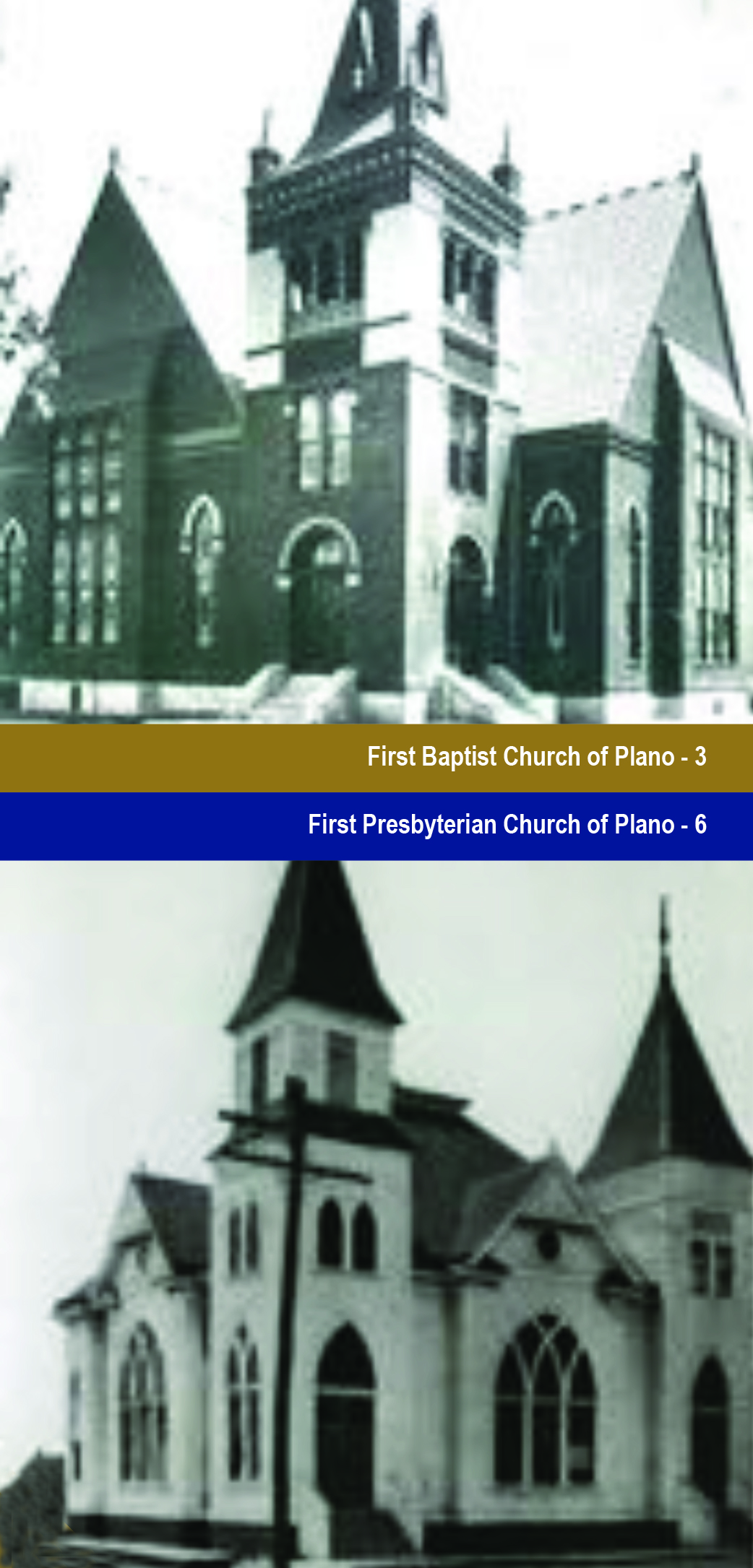
Formally organized in 1853 as the Spring Creek Baptist Church, the first sanctuary was built about two miles south of this location. After the railroad came to Plano, the congregation moved to its current location in 1875. A new sanctuary was constructed in 1898 and the church was renamed First Baptist Church of Plano about 1936. The current sanctuary was built in 1970.
4. Liberty Baptist Church 5701 W Park Boulevard
Liberty Baptist Church was formed in 1850, with Eli Witt serving as the first pastor until 1856. In 1885 a white frame structure was erected in this location. The current brick structure was erected in 1976. The church is the oldest Baptist congregation in continuous service in Collin County.
5. First Methodist Church of Plano 1111 18th Street
This congregation traces its history back to a meeting of 13 people in 1846 or 1847 at the home of Joseph and Elizabeth Russell. With the coming of the railroad in 1874, the church moved to its second location on Avenue L, a few blocks south of 15th Street. In 1895, the church moved to its third location at 16th Street and K Avenue and in 1968 to its fourth location at 18th Street and M Avenue. The congregation moved to its current on Spring Creek Parkway in 2002.
6. First Presbyterian Church of Plano 1500 Jupiter Road
(1923) The style of this building has been dubbed Prairie Beaux Arts. The two-story brick structure with a raised basement, central double loaded corridor, and stair towers at each end was renovated in 2005 and is currently used as training rooms, offices, and rehearsal halls. The entire school district (K-12) was Mid Century Today 21 20 housed in this facility until the early 1950s.
Publications
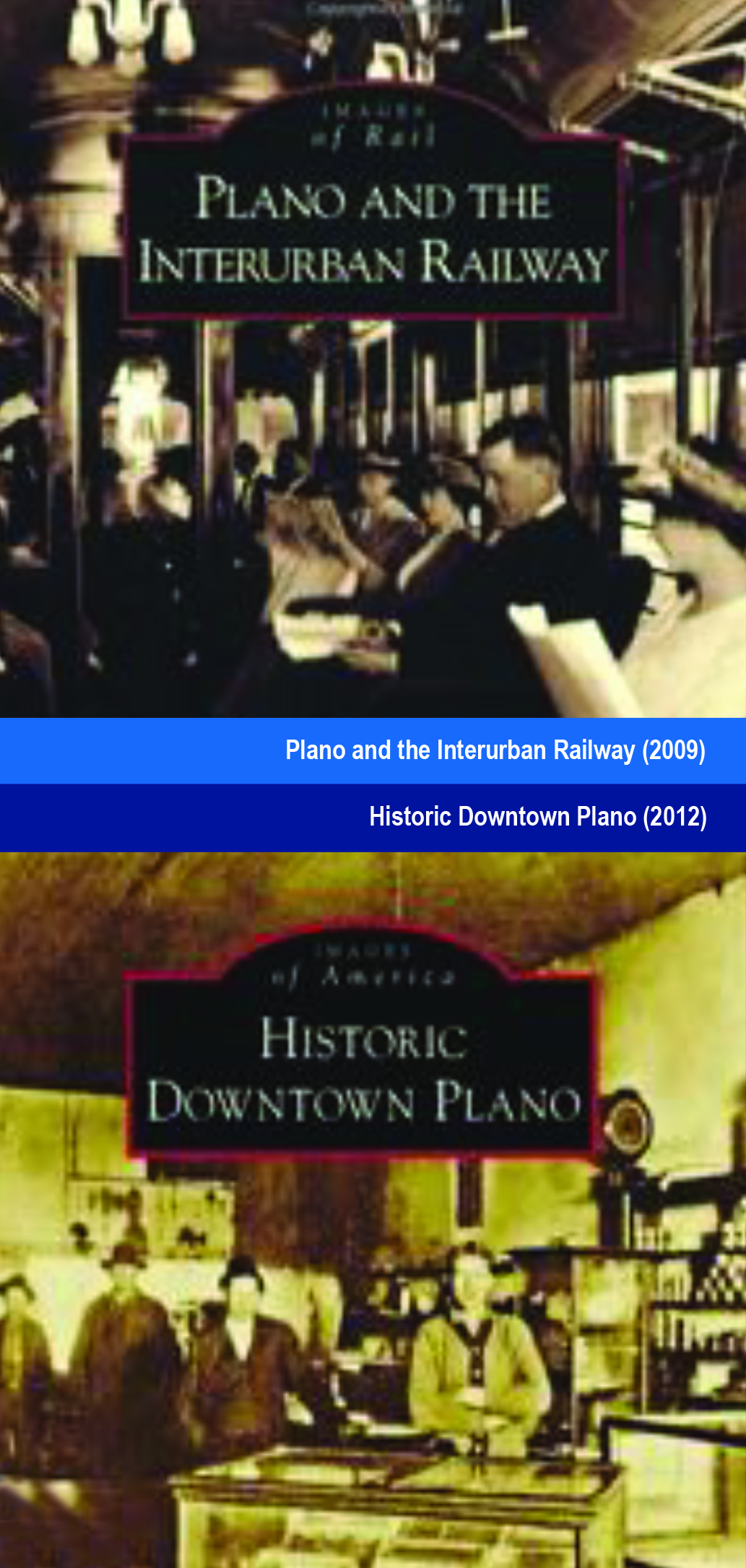
1. Plano and the Interurban Railway The Plano Conservancy for Historic Preservation
(2009) Over a century ago, an industrial America was awakening, and a new transportation technology arrived on the north Texas prairie: electric interurbans. Plano’s Interurban Railway depot was Plano and the Interurban Railway (2009) Historic Downtown Plano (2012) 22 dedicated in July 1908, and electric interurban rail travel began with the creation of the Texas Traction Company. In 1917, three separate systems were connected by a single entrepreneur, J. F. Strickland. Throughout the 1920s, the Texas Electric Railway traveled in and out of Plano carrying riders, mail, and freight. The system was built to travel on existing streetcar tracks and often ran over private rights-of-way between cities. To promote interurban travel, the company created unique cars and special classes of service to appeal to every need. In the post–World War II era, however, the popularity of automobiles ended the important era of electric interurban travel.
2. Historic Downtown Plano Janice Craze Cline
(2012) Historic Downtown Plano focuses on the citys main mercantile area of Mechanic (Fifteenth Street) and Main (K Avenue) and the surrounding heritage districts of Haggard Park, Old Towne, and the Douglass Community. Incorporated in 1873, downtown Plano has endured at least five major fi res, the Great Depression, closure of the interurban railway, and retail and corporate development to the west of the area. In recent years, downtown Plano has benefited from ongoing redevelopment and revitalization as an urban transit village with the Dallas Area Rapid Transit (DART) light rail train service to the area taking us back to those days of old.
3. Plano’s Historic Cemeteries The Plano Conservancy for Historic Preservation (2014)
The Plano of today would not be recognizable to the pioneers who settled this section of the blackland prairie. Arriving in the early 1840s, these colonists from Tennessee and Kentucky were captivated by Sam Houston’s stump speeches about the rich, fertile farmland of North Texas. All of their frontier cemeteries, large and small, are now surrounded by golf courses, subdivisions, and commercial development. The final resting places of Planos pioneers still exist because of the hard work of cemetery associations, civic groups, concerned citizens, the City of Plano Parks Department, and the Plano Conservancy for Historic Preservation. These silent spaces hold a wealth of history that helps tell the story of Planos beginnings as a rural farming community.
4. Saving Plano’s Treasures The Plano Conservancy for Historic Preservation (2016)
This coloring book features twelve historic locations around Plano, Texas and details their significance in Plano’s early history. This book is perfect for both children and adults who want to learn more about the most significant sites around the City of Plano. This book is currently only available in-person at the Interurban Railway Museum, and is yours for a donation of your choice. All donations will be used to purchase school supplies for Plano Plano’s Historic Cemeteries (2014) Football and Integration in Plano, Texas (2014) 23 ISD elementary schools.